

5 min read
“Why do your buildings have American flags on them?” Mom asked me as I was finishing off the sky on my latest drawing. “Our flag is too hard!” I exclaimed. And for a preschooler, it surely was. The flag of Canada at the time was the Canadian Red Ensign. It was one part Union Jack and one part Shield of Canada, all on a red background. Tricky to reproduce, especially with crayons.
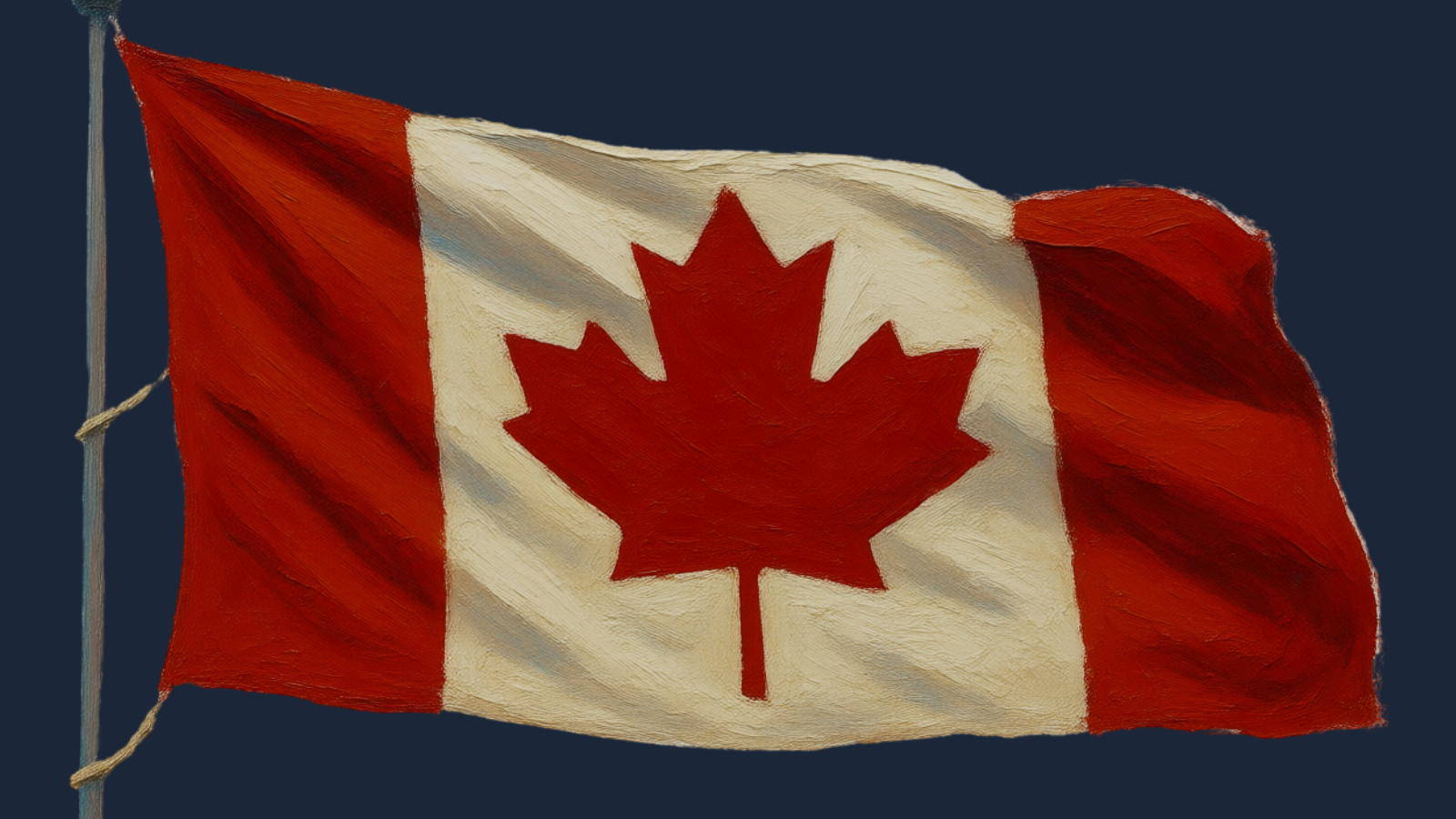
“Well, we have a new flag now,” my mom informed me, “and it’s even easier to draw than the American flag.” She then joined me on the floor where I was sprawled out with my paper and wicker box brimming with assorted crayons, and proceeded to show me. “All you need is your red,” she told me, as she peeled back the paper on one of my well-used red crayons. “You make a thick red line on one side of the flag,” she demonstrated, “and one on the other side, and then in the middle, you draw a maple leaf.” I knew all about maple leaves. Maple trees grew all around the lake across the street. In Nova Scotia, where I lived as a child, the Red Maple is a major contributor to the signature autumn colours of the Maritimes that draw so many tourists each Fall. “Why are the sides red?” I asked. Mom explained that the red bars on each side of the flag represent the eastern and western borders of the country. “This one on the right is the Atlantic coast, where we live,” she said, “and this one on the left is the Pacific coast, where Aunt Lydia lives.” While I didn’t know where that was exactly, I knew it was far away. Every Christmas when Aunt Lydia called, we’d have to “come quickly!” because “it’s long distance!” and I could only speak with her for a short time before having to hand the phone over to one of my siblings. “So, our new flag is very special,” my mom said proudly, “because it’s for all Canadians, from sea to sea.” I was convinced. So, that day marked a turning point in my drawing career. Instead of American flags, all my forts had Canadian flags flying. And in time, my central red squiggle began to vaguely resemble the flag’s eleven-point stylised maple leaf.
Over the years, I grew to love our flag, and felt a sense of pride every time I saw one. And there were no shortages of such times. A Canadian flag stood at the front of our elementary classroom next to the portrait of Queen Elizabeth. Every morning, after our teacher would get our attention, we would stand beside our rows of desks. Facing the flag, we would sing the Canadian National Anthem, followed by “God Save the Queen,” and finish by reciting The Lord’s Prayer. On the army base where my dad worked, there were flags everywhere. In addition to the guardhouse at the Main Gate, the Canadian flag was prominently featured on the central flag pole outside the headquarters, on the parade square, and at the Officers’ Mess, where we’d meet Dad. It was also on display in the auditoriums and lecture halls, flanking the chancel at church, and even inside the movie theatre on the base. Before the trailers and feature film, red curtains would be drawn open revealing the screen with a close-up view of Parliament Hill. There in the centre was the Peace Tower with the Canadian flag majestically waving in the breeze. The National Anthem would then begin, and we’d all rise, as our seats snapped vertical. And then with cola in one hand and popcorn in the other, we’d enthusiastically sing “O’ Canada” together. While this degree of patriotism may seem rather odd today, it didn’t then. We were Canadian and we were proud. And for good reason. Many had relatives who had died in the world wars defending our country. Vimy Ridge, Passchendaele and Juno Beach were well-remembered battles and taught in history class. Canada was highly respected on the world stage for diplomacy and as a peacekeeping nation. Tourists loved to visit our world-famous vistas, and Canadians travelling abroad were warmly received.
Unifying a country the size of Canada takes some doing. The inauguration of our iconic red and white maple leaf flag on Parliament Hill in 1965 was a step in that direction, but certainly not the first. A century earlier, John A. MacDonald had envisioned uniting the newly-minted dominion by rail. As Pierre Berton described in his book, The National Dream, the project was “a rare example of a nation created through the construction of a railway.”[1] Or in the words of Gordon Lightfoot in his “Railroad Trilogy”, “an iron road runnin’ from the sea to the sea.” And to a certain extent, it was successful. The Canadian National Railway physically united the country. People and goods moved regularly across our vast landscape. But as Berton also observed, there’s more to binding a nation than “parallel lines of rusting steel.” Fortunately, the Fathers of Confederation were aware of that. Drawing substantially from a Christian moral worldview, the founders and institutions of Canada chose to bind our country with that which is eternally good and true. Our national motto, “A Mari Usque Ad Mare” – which in Latin translates “From Sea to Sea” – is directly derived from the Book of Psalms: “He shall have dominion from sea to sea, and from the river unto the ends of the earth” (Psalm 72:8). The naming of our country as the “Dominion of Canada” in 1867 also reflects this influence. As well, our National Anthem derives from a Christian hymn of praise. Although the words were modified, the Christian sentiment remains with the phrase, “God keep our land glorious and free,” and reflects the understanding that national flourishing ultimately depends upon God. Our British-inherited constitution and system of jurisprudence are also founded upon Biblical principles. This has been reaffirmed more recently in the preamble of our Charter of Rights and Freedoms, which recognises the supremacy of God. All in all, Canada was founded as a constitutional order whose institutions, legal assumptions, and symbols were deeply informed by Biblical Christianity. This transcendent tie bound us.
What is the tie that binds us today? In our contemporary secularised culture, where the Bible is considered myth – and even hate speech – and Christianity is derided and blamed for our societal ills, what holds us together as Canadians? Is it our cultural quirks, like saying “sorry” for saying sorry so much, or ending our sentences with “eh?” Or is it our mutual complaining about the weather, our frustration over our under-performing hockey team, our proclivity for forming long line-ups at Timmies take-out… or our shared embarrassment over the beaver as our national animal? Or are we bound by what we oppose, like “elbows up” in response to U.S. tariffs, or anything Donald Trump says or does? Or is it our international reputation for being “nice” … or for having the most liberal policies for euthanasia in the world, or for being counted with North Korea for lacking any laws on abortion? Or is the tie that binds us together our sexual identity politics? Does being Canadian mean an embrace of identity confusion and sexual perversion? Is Pride Month where our pride derives? The prominent presence of the rainbow flag would certainly suggest so, as does the popular adulteration of our Canadian flag with rainbow bars in place of the red ones.
If human dignity, equality, justice, freedom and compassion still matter to us – if they are to continue as shared values that define our nation – they need a firm foundation. Diversity doesn’t bring unity; it merely confirms disunity. By contrast, history records that societies that embrace creational norms and biblical truths attain the highest freedom, justice, and prosperity. Any tie that doesn’t bind with what is transcendent, eternal, good and true will ultimately fail. As the psalmist warns, “Unless the Lord builds the house, those who build it labor in vain” (Psalm 127:1). Our current trajectory will only bring woe, Canada.
Editor’s Note: This article was originally published on the author's Substack. Republished here by permission.
[1] – Pierre Burton, The National Dream, The Great Railway, 1871-1881 (Toronto: McClelland and Steward, 1970), 11.


Alberta’s future depends on Christians who are equipped to observe all that Christ commanded in the public square. Partner with us to cultivate Christian thought and action right here at home.
For just $10 a month, your partnership directly funds the resources, campus outreach, and reform initiatives that push back against quiet disengagement. By subscribing to Alberta Reformer+, you aren’t just reading—you are actively mobilizing believers across our province.
Our goal is to grow the community to 400 members by the end of this year.
Will you be one of them? Partner with us today and fuel the reform.